Privacy Protections for Flock Cameras in Novi
Why I Am Concerned About Flock
I learned earlier this year that Novi purchased 10 Flock cameras in 2023. Knowing these cameras are in my community made me pay attention to reports about their use and misuse throughout the country. In particular multiple reports of Flock data being shared, accidentally or on purpose, with ICE as well as reports on ICE’s illegal activities throughout the country have made me worry for my immigrant children and my immigrant neighbors here in Novi. Some examples include:
- Officers using cameras to track romantic partners. The Institute for Justice’s compilation of license-plate-reader misuse includes a police chief used Flock to stalk his ex-girlfriend.
- Surveillance of protests and activists. An Electronic Frontier Foundation investigation found that dozens of agencies have conducted hundreds of Flock searches to find protesters and activists.
- Local data reaching federal immigration agencies without a direct sharing agreement. In Syracuse, Flock data included in 175 CPB-related searches even though the department had not entered a data-sharing agreement with those federal agencies, according to Central Current’s reporting.
- Camera feeds exposed to the internet. 404 Media found at least 60 Flock Condor cameras completely open to the public due to poor security.
- Errors that put innocent people at risk. The Institute for Justice’s database of ALPR abuse documents wrongful stops and detentions as well as deliberate misuse of this technology.
How does Novi protect residents’ privacy?
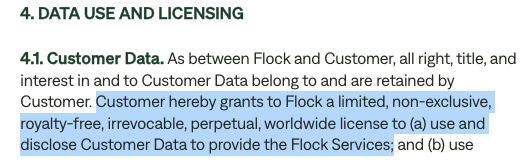
I have reviewed Novi’s contract with Flock, a short document consisting mostly of a link to the Flock Terms of Service. Flock’s Terms of Service says that Novi “grants Flock a limited, irrevocable, perpetual, worldwide license to use and disclose [our data] to provide the [Flock] service”—not much of a privacy guarantee.
I searched the Novi Web site for ordinances that protect residents’ privacy from this technology, similar to Detroit’s Community Input Over Government Surveillance ordinance, but I was not able to find a comparable Novi ordinance.
I watched the Now You Novi episode on Flock cameras, which talked in general terms about privacy, but did not include any specifics on the policies, accountability mechanisms, or how we make sure they are enforced. I have requested these policies from the city in a Freedom of Information Act request, but have yet to receive them.
Ordinances in Other Communities
Detroit’s surveillance ordinance requires public review and Council approval before acquiring technology like Flock, written safeguards governing use, access, retention and sharing, and reports on misuse and corrective action; it also provides for employee discipline and protects whistleblowers. The California ACLU’s Making Smart Decisions about Surveillance has model ordinances with similar calls for enforceable use policies, annual public reporting, and ongoing Council review, with authority to stop surveillance when safeguards are inadequate.
What I Am Asking Novi to Do
- Publish the protections we already have. Post Novi’s Flock policies, sharing rules, retention limits, and complaint process.
- Show whether those protections work. Publish reports on access, audits, misuse, and disciplinary action.
- Put enforceable protections into law. Establish oversight, limits on use and sharing, employee accountability, and whistleblower protection.
What is Novi’s agreement with Flock?
I obtained Novi’s signed Flock agreement through the Freedom of Information, a short document with no privacy provisions, binding the City to the Terms of Service at Flock’s website.
Flock’s online Terms and Conditions grants Flock a “limited, irrevocable, perpetual, worldwide license to use and disclose it to provide the service, and to use it to improve Flock’s products and services.” I did not see any provisions to protect our residents’ privacy.

Detroit Shows What a Local Ordinance Can Require
Detroit’s Community Input Over Government Surveillance ordinance, covers automatic license-plate readers like Flock and other surveillance technology. It provides a concrete starting point for Novi:
- Public review before procurement (§452): Council approval and opportunities for public comment, with a specification report online at least 14 days before the required hearings or meetings; approved reports remain public while the technology is used or possessed.
- Written safeguards (§453): The report must describe permitted and prohibited uses, civil-rights impacts, access controls, retention and deletion, sharing recipients and restrictions, oversight, training, and complaints.
- Reporting (§§454–456): Required use reports cover sharing, complaints, internal audit results, violations, responses, and misuse. Police report through their annual operations report; Council’s annual public report includes the use reports issued the preceding year.
- Employee accountability (§459): Unauthorized, discriminatory, and viewpoint-based uses are prohibited; violations subject employees or agents to appropriate discipline, and good-faith whistleblowers are protected.
There are limits: the ordinance allows emergency uses and certain Council-approved nondisclosure agreements (§§457–458). It does not impose a universal warrant requirement, a fixed retention period, or automatic dismissal for misuse. These are requirements on paper; I am not claiming to have verified Detroit’s compliance.